Bare PCB Quality Evidence

A bare PCB test report should answer a specific fabrication question and identify the lot and revision it represents. We separate electrical continuity and isolation, controlled-impedance measurement, dimensional checks and structural inspection. The customer defines special standards, limits and report expectations before the board enters production.
Bare-board testing ends before component function begins
The evidence covers the fabricated PCB: conductors, insulation paths and selected physical structures. It does not prove solder-joint quality, component identity, firmware or assembled product function.
Those later risks need a separate PCBA inspection and test plan.
Released net data define electrical connectivity
Gerber or ODB++ and netlist information establish which points should connect and remain isolated. We reconcile the applicable revision before preparing electrical test data.
A changed design requires regenerated test data; a previous program is not reused merely because the outline is the same.
Flying-probe electrical test supports flexible volumes
Flying probes can access test locations without a dedicated fixture and are often suitable for prototypes or changing designs. The program checks continuity and isolation according to the defined data and test conditions.
Probe access, board size and test time affect suitability. Report detail is agreed for the order.
Fixture testing can support stable repeat volumes
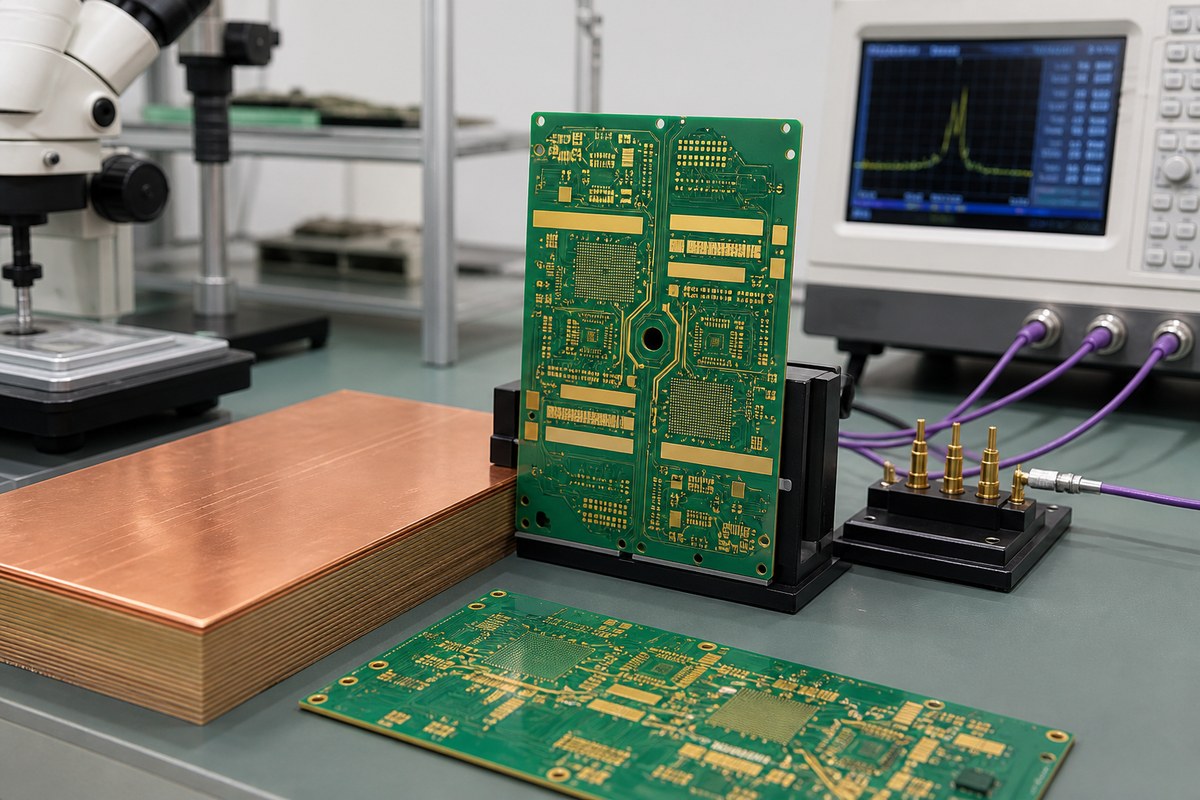
A dedicated fixture can test many points efficiently once design and volume justify tooling. Fixture identity and revision need control so the correct product uses the correct test.
A PCB change may require fixture review or modification before release.
Continuity criteria need thresholds
Continuity testing identifies unintended opens or excessive path resistance within the specified method. Special low-resistance or high-current requirements need explicit values and appropriate equipment.
A standard continuity pass is not represented as precision resistance measurement.
Isolation testing needs voltage and acceptance definitions
For standard net testing, the selected isolation parameters follow the agreed route. High-voltage, insulation-resistance or dielectric testing requires customer-specified points, voltage, waveform, duration and limit.
EBest does not infer a safety test value from the product’s nominal voltage.
Controlled impedance uses defined coupons
Target, tolerance, layer, reference, stack-up, geometry, coupon and measurement method are confirmed. The report links the measured coupon structures to the fabrication lot.
A coupon does not measure every routed trace or complete channel behavior.
Dimensional inspection covers identified critical features
Outline, thickness, holes, slots, routing, connector edges or other dimensions can be checked according to the drawing and sampling plan. Critical locations must be identifiable.
A general dimensional report may not include every design feature. Report fields are agreed before fabrication.
Microsection provides selected structural evidence
A prepared section can examine specified hole, plating, layer or special-process structures. Sample location, orientation, quantity and acceptance criteria determine relevance.
The method is destructive and represents the inspected sample. It is not automatically unit-level proof.
Special structures need purpose-built inspection
Blind or buried vias, filled and capped vias, backdrill, edge plating and other features may require additional inspection. The method is matched to the requirement rather than selected because a machine is available.
Any destructive coupon should reproduce the relevant production structure.
Test records remain tied to lot and revision
EBest can connect the applicable electrical, impedance, dimensional or structural result to the work order and released construction within the agreed system scope.
Report retention, delivery and identifiers are defined before production.
Sampling plans must identify the population
A destructive section or dimensional sample needs a defined lot, panel location and quantity. The customer specifies any required standard or approved sampling basis. EBest records what was inspected and does not extend the result to a different construction.
Where every-board electrical test is required, the release status reflects the actual tested population.
Test equipment and references need valid status
Measurement systems, fixtures, coupons and reference data are controlled for the intended test. Special customer calibration or traceability requirements must be stated in the RFQ.
A valid instrument does not correct an incorrect program, fixture or product revision, so those links are reviewed together.
Failed results follow nonconformance control
Affected product is identified and prevented from unintended release. Investigation and any customer concession or rework are documented.
A later pass does not erase the initial failure where complete history is required.
Bare-board evidence matrix
| Question | Method | Evidence limit |
|---|---|---|
| Are intended nets connected? | Flying probe or fixture continuity | Defined threshold and accessible test data |
| Are separate nets isolated? | Electrical isolation test | Specified voltage and limit |
| Does a controlled structure meet target? | Coupon impedance measurement | Representative coupon only |
| Are critical dimensions within drawing? | Dimensional inspection | Selected features and sampling |
| Does a special structure meet acceptance? | Microsection or agreed inspection | Destructive sample and stated location |
Inputs for an EBest bare-board test plan
- Released image, drill and net data.
- Fabrication drawing and stack-up.
- Applicable standard and acceptance class.
- Continuity and isolation special conditions.
- Impedance structures and coupon requirements.
- Critical dimensions and tolerances.
- Special via or structural inspection requirements.
- Sampling, report format and retention.
What EBest returns
We can return the agreed test scope, lot-linked electrical status, impedance report, selected dimensional or structural evidence and nonconformance disposition where applicable. This gives the customer proof tied to the actual bare board instead of a generic statement that “all PCBs are tested.”
Discuss Your Project With Our Engineers
Send us your PCB files, drawing, acceptance standard and required reports. We will define the applicable bare-board inspection and test evidence before quotation.
Email sales@ebestpcba.com with the current revision and expected quantity.
For your bare-board order, we will confirm which tests apply, the acceptance criteria and the report format before fabrication. You can then match the supplied evidence to the relevant lot and revision.