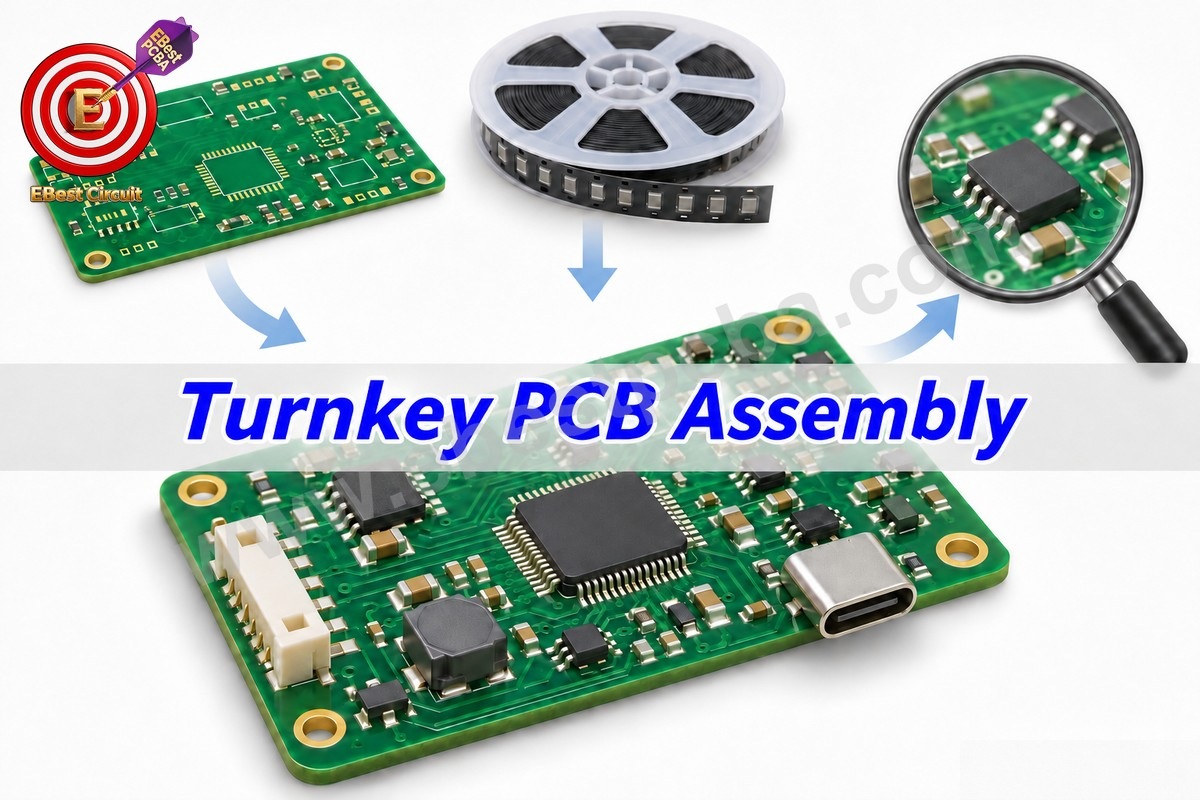
turnkey pcb assembly is a manufacturing arrangement in which one supplier coordinates bare-board fabrication, component procurement, assembly and the inspection or testing agreed for the project. You provide the design and build requirements; the supplier manages the production activities within that scope. Full turnkey includes sourcing the required components, while partial turnkey lets you supply selected parts.
The practical benefit is fewer handoffs between board fabrication, purchasing and assembly. However, “turnkey” does not automatically include circuit design, firmware development, functional-test fixtures or enclosure assembly. Those requirements need to appear in the quotation. At EBest PCBA, we connect PCB fabrication, component sourcing and assembly around your approved project files. Send your Gerber or ODB++, BOM, placement data and quantity so we can review the build.
Key Takeaways
- Turnkey defines manufacturing responsibility. The quotation still determines the exact services and deliverables.
- Full turnkey, partial turnkey and consigned assembly differ mainly in who supplies the PCB and components.
- BOM, PCB data and placement files must describe the same released design revision.
- Component alternates need approval before purchasing or production release.
- Visual inspection, X-ray and functional testing answer different quality questions.
- Total cost and delivery timing depend on materials, assembly work, testing and unresolved approvals.
What Do Turnkey PCB Assembly Services Include?
Turnkey PCB assembly services generally combine PCB fabrication, component sourcing and populated-board assembly under one project contact. Inspection, electrical testing, programming and other operations depend on the agreed work package.
Separate the standard assembly route from additional product work before comparing quotations. A populated board may still need firmware, calibration or enclosure installation before it becomes a usable product.
| Build activity | Scope to agree |
|---|---|
| PCB fabrication | Construction, material, finish, panelization and bare-board test requirements |
| Component procurement | Approved part numbers, supply responsibility, alternates and material quantities |
| Assembly | SMT, through-hole or mixed assembly, populated sides and mechanical operations |
| Inspection and testing | Methods, coverage, acceptance criteria and result records |
| Additional operations | Programming, coating, calibration, box build and packaging where specified |
Our turnkey PCBA assembly service explains the manufacturing route and the information needed to define a project-specific scope.
How Does Full Turnkey PCB Assembly Differ From Partial Turnkey?
Full turnkey PCB assembly places component procurement with the assembly supplier. Partial turnkey splits procurement between you and the supplier. In a consigned build, you normally provide the component kit and may also provide the bare boards.
The responsibility split should be recorded by material line. A label such as “partial turnkey” is not enough to determine who buys a connector, supplies spare components or resolves a shortage.
| Model | Component supply | Typical reason to choose it |
|---|---|---|
| Full turnkey | Supplier procures the agreed BOM | Keep sourcing and assembly coordination with one team |
| Partial turnkey | Customer and supplier each supply specified BOM lines | Use strategic inventory or customer-controlled parts |
| Consigned | Customer supplies the component kit | Use existing stock or established purchasing contracts |
For customer-supplied parts, agree the received quantity, packaging condition and handling of unused material. Confirm bare-board supply separately, because terminology varies between suppliers.
When Is Turnkey Assembly a Good Fit?
Turnkey assembly is useful when a team wants to outsource manufacturing coordination while retaining control of the product design. It can suit prototypes, pilot builds and repeat production, provided the release and approval process matches the project stage.
- Prototype development: combine sourcing questions and assembly feedback before committing to a larger order.
- Small engineering teams: reduce the work of coordinating separate board and component deliveries.
- Repeat production: maintain an approved BOM and build record across orders.
- Mixed-technology boards: coordinate SMT and through-hole operations within one manufacturing route.
Partial turnkey can be more practical when you hold allocated semiconductors or have mandatory purchasing agreements. Consigned assembly may fit an established kit. Choose the model around available material and control requirements rather than assuming full turnkey is always the lowest-cost option.
Which Files Are Needed for a Turnkey Assembly Quote?
A useful quotation package includes PCB manufacturing data, a BOM with manufacturer part numbers and a placement file. Quantity, assembly drawings and test requirements make the scope clearer and reduce assumptions.
| File or requirement | Essential content |
|---|---|
| Gerber or ODB++ | Copper, mask, legend, outline and drill information as applicable |
| Fabrication drawing | Stack-up, thickness, material, finish and special construction requirements |
| BOM | Reference designators, quantity per board, manufacturer, MPN and DNP status |
| Pick-and-place or centroid data | Reference, X/Y position, rotation, side, units and coordinate origin |
| Assembly drawing | Polarity, orientation, mechanical notes and special assembly instructions |
| Test and programming package | Firmware version, procedure, connections, operating conditions and pass/fail limits |
| Order details | Build quantity, variants, target timing and delivery destination |
Mark “do not populate” positions consistently across the BOM and drawings. If your product has variants, identify which parts change for each version. A placement file alone does not define the component manufacturer or electrical specification.
You can begin a discussion with incomplete data. Production should wait for a complete, approved release package with open questions resolved.
How Does the Turnkey PCB Assembly Process Work?
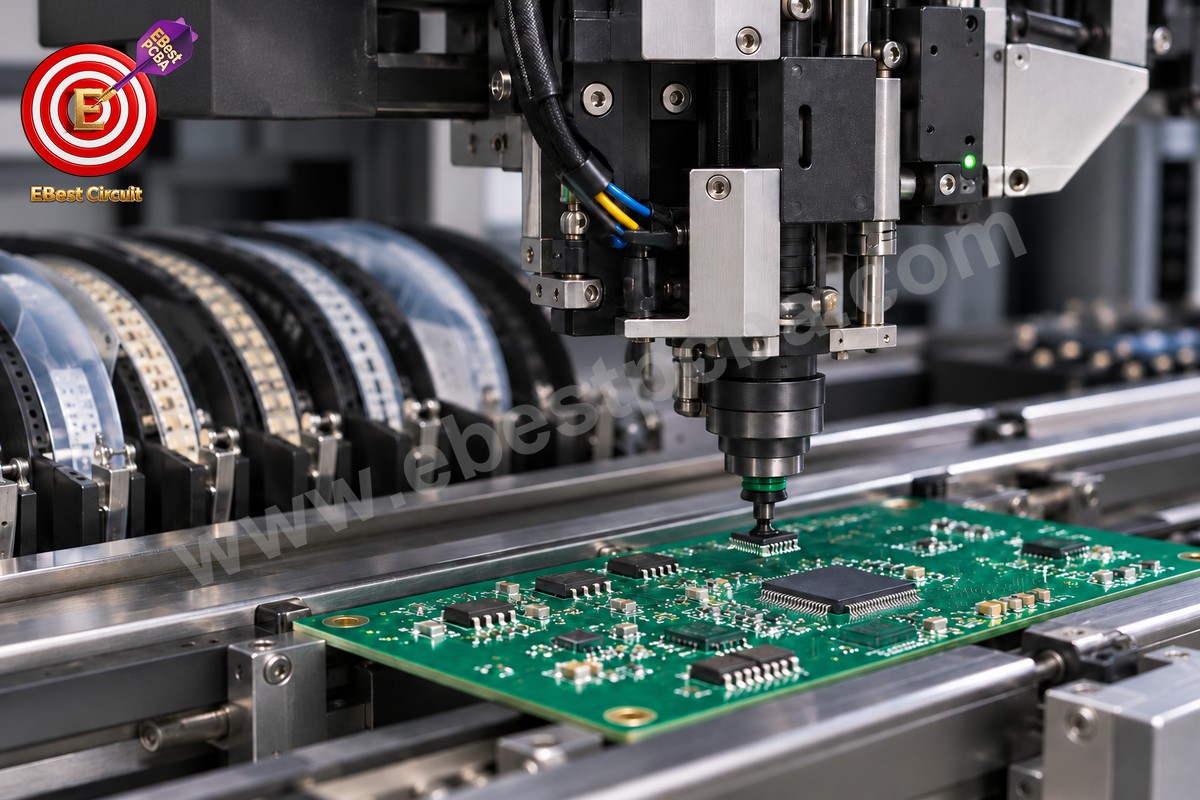
The process moves from file review and sourcing decisions to fabrication, assembly, verification and shipment. PCB production and component purchasing can run in parallel after the relevant inputs are approved.
- Review the package. Confirm quantity, design revision, material responsibility and manufacturing scope.
- Resolve engineering questions. Close footprint, construction, panelization, polarity and test-access issues.
- Approve the quotation and materials. Record alternates, availability limits and outstanding customer decisions.
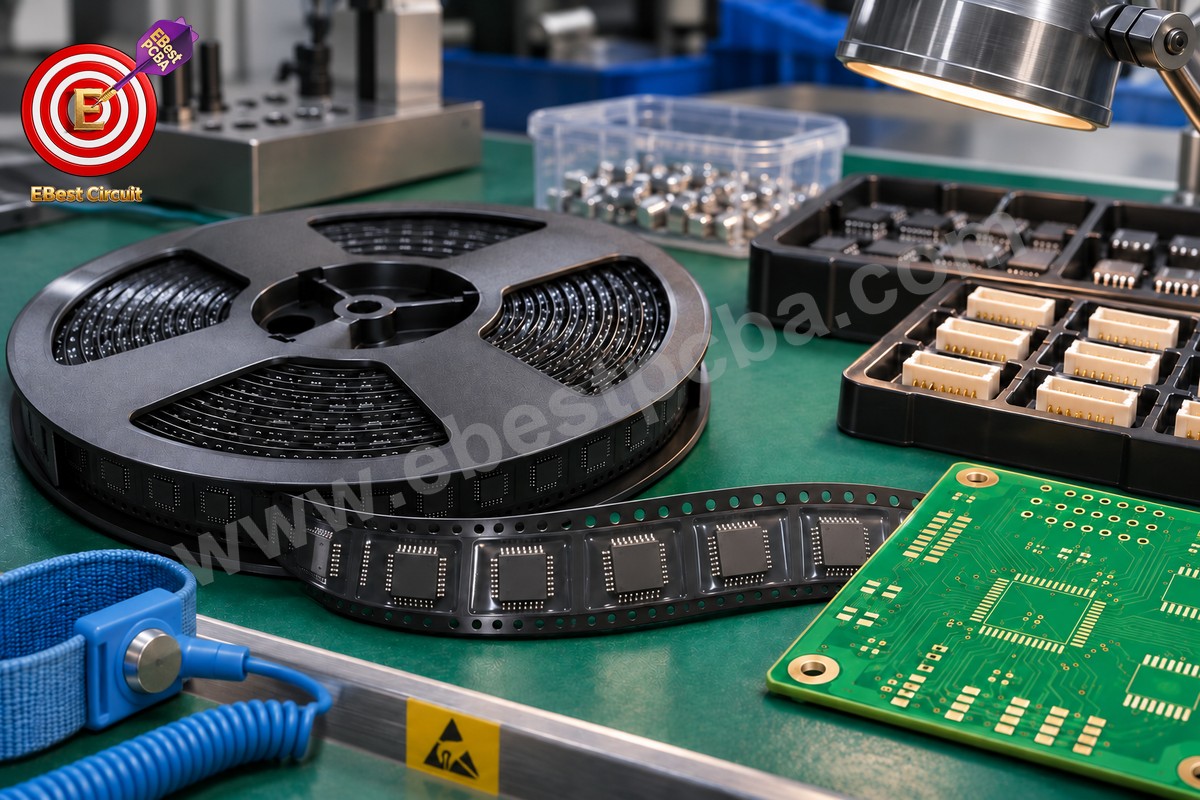
- Prepare boards and components. Fabricate the PCB and receive, inspect and kit the required material.
- Set up assembly. Prepare the stencil, placement data and soldering process for the approved build.
- Assemble and verify. Complete SMT and through-hole operations, then apply the defined inspection and test plan.
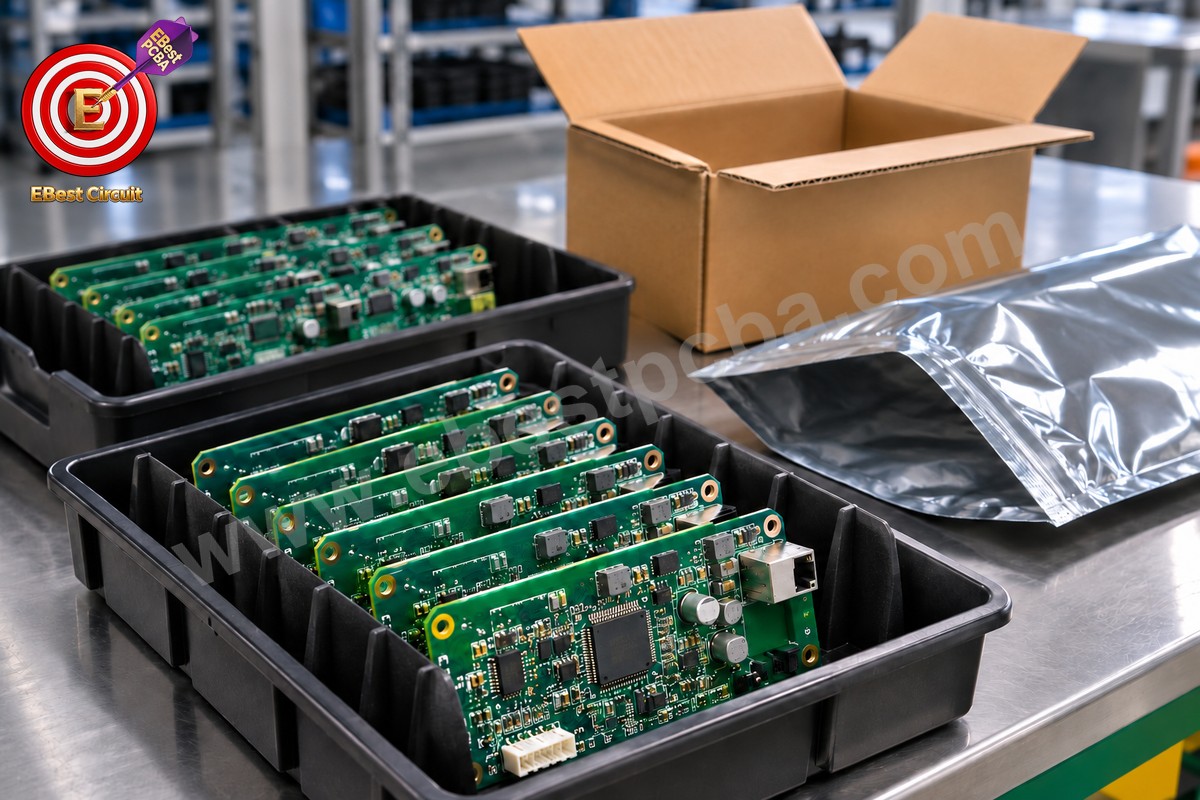
- Release the shipment. Check the agreed records, identification, packaging and delivery instructions.
First-article review can catch setup or interpretation problems before the remainder of a batch proceeds. Agree what requires approval and who can release it, particularly when a prototype introduces a new footprint or mechanical fit requirement.
How Are Component Sourcing and Substitutions Controlled?
Component sourcing should follow approved manufacturer part numbers, with proposed substitutions reviewed before purchase or use. Matching a resistance value, package name or short description is insufficient to establish interchangeability.
For example, two capacitors with the same nominal capacitance can differ in voltage rating, dielectric and dimensions. A connector alternative may fit the board footprint but fail to mate with the specified cable. An IC replacement may require firmware changes or renewed product validation.
Our component sourcing and BOM review addresses availability, lifecycle and alternate-part questions before procurement. Customer-locked part numbers remain approval constraints. For consigned items, provide readable labels and the handling information needed to receive and store the material correctly.
What Should DFM and Assembly Review Catch?
DFM and assembly review should identify manufacturing obstacles and conflicting inputs before boards or components are committed. The review checks whether the supplied design data can support the intended fabrication and assembly route.
- Footprints, pin numbering and package dimensions that disagree with the selected component.
- Unclear polarity or orientation on diodes, capacitors, ICs and connectors.
- Insufficient access for placement, soldering, rework or inspection.
- Panel edges, tooling features and component locations that complicate handling.
- Missing test access or undefined programming connections.
A manufacturing review does not validate the circuit design or prove that the product meets its application requirements. Use our DFM review report structure to understand how findings and approval decisions can be organized. Keep the final corrections synchronized across the PCB files, BOM and drawings.
Which Inspections and Tests Should Be Specified?
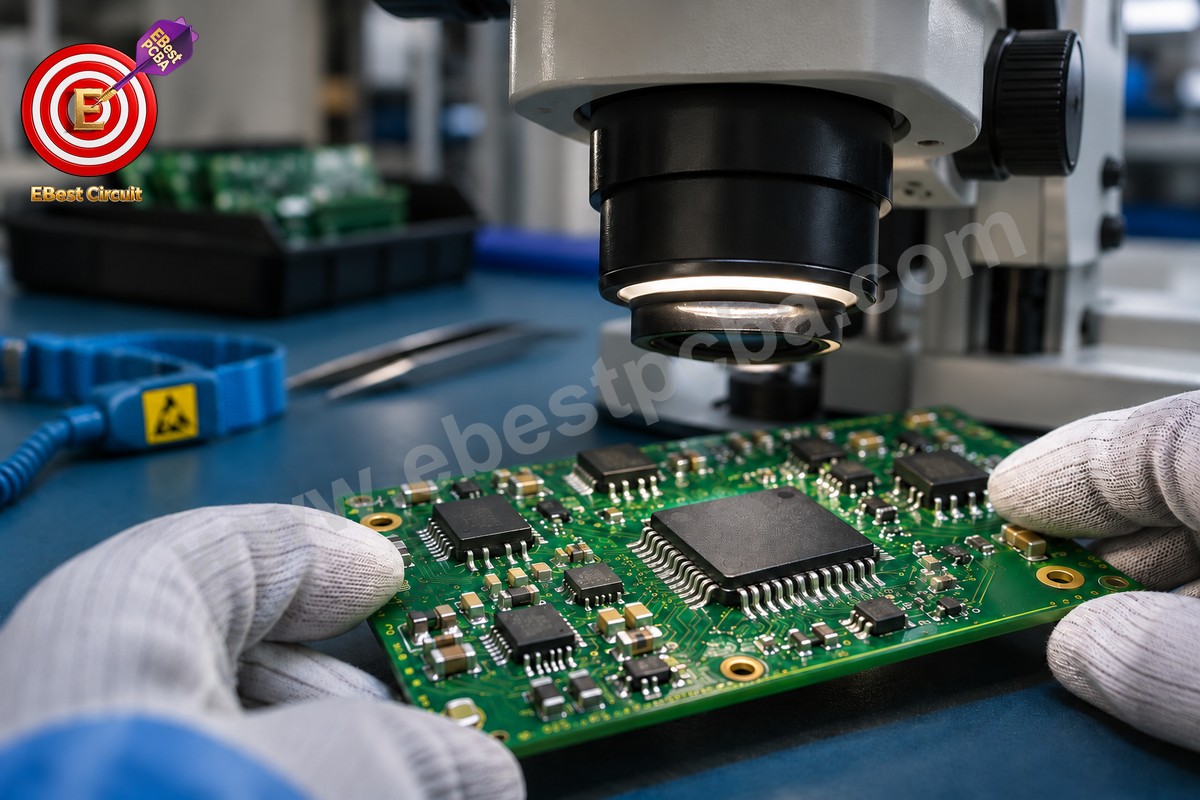
The inspection and test plan should match the assembly risks and the faults the project needs to detect. No single method covers solder workmanship, hidden joints, electrical connections and operation under load.
| Method | Main assessment |
|---|---|
| Solder paste inspection | Paste deposit characteristics before component placement |
| AOI | Visible placement and solder features within the inspection program |
| X-ray | Hidden solder-joint features, including suitable bottom-terminated packages |
| Electrical testing | Defined connection or component checks using the selected test method |
| Functional testing | Specified operation with agreed firmware, conditions and pass/fail limits |
A board that passes AOI has not automatically passed a functional test. Likewise, a successful power-on check may leave communications, sensor accuracy or load behavior untested. Define the actual functions and operating limits rather than requesting only “fully tested boards.”
Agree inspection coverage, sampling where applicable, acceptance criteria and the records supplied with the order. Confirm responsibility for test fixtures, software and reference units before accepting a test quotation.
What Affects Turnkey PCB Assembly Cost?
Turnkey PCB assembly cost combines bare boards, components, assembly labor and setup, plus the inspection and testing specified. There is no reliable universal price per board without the BOM, construction and quantity.
- PCB construction: layer count, material, dimensions, finish and special features.
- Component purchase: part selection, availability, order multiples and procurement quantities.
- Assembly work: populated sides, placement count, through-hole operations and manual work.
- Non-recurring work: stencils, programming preparation, fixtures and test development.
- Delivery scope: packaging, freight and the agreed commercial terms.
Compare quotations at the same build quantity and revision, with the same inspection and test requirements. Ask which charges recur on repeat orders. Component order multiples can leave unused stock, so clarify ownership and whether that material will be returned or held for a later build.
What Determines Turnkey Assembly Lead Time?
Lead time depends on engineering release, material readiness, manufacturing and verification. The longest unresolved dependency can control shipment even when the assembly work itself is short.
After approval, PCB fabrication and component procurement may proceed together. Assembly then depends on both being ready. A late connector, unresolved substitute or missing functional-test fixture can delay that transition.
- Confirm what triggers the quoted production clock.
- Separate production completion from freight transit and arrival.
- Identify long-lead material before committing to a delivery date.
- Assign approval contacts for engineering questions and first articles.
A requested delivery date is useful planning input, but it becomes a commitment only through the confirmed quotation and order terms. Avoid assuming that a bare-PCB prototype lead time also applies to a complete assembly.
How Should You Choose a Turnkey PCB Assembly Manufacturer?
Choose a turnkey PCB assembly manufacturer by its ability to handle your actual build, document decisions and supply the agreed evidence. A broad capability list is less useful than a clear response to your files and requirements.
Ask how the team handles an unavailable BOM line, a footprint discrepancy and a failed functional test. Those answers show where decisions are recorded and how a problem returns to engineering for resolution.
- Confirm relevant package and assembly support against the submitted design.
- Review sourcing routes and the alternate-approval process.
- Agree inspection, test deliverables and traceability requirements.
- Check revision control, ownership of fixtures and handling of remaining material.
- Compare commercial scope, schedule assumptions and the escalation contact.
For a repeat build, identify the approved BOM, firmware and manufacturing revision in the purchase order. A previous successful batch does not authorize silent changes to parts or process requirements.
Plan Your Turnkey Assembly Build With EBest PCBA
Start with a defined build package and a clear split of manufacturing responsibilities. That gives sourcing, production and quality teams the same reference when they prepare the quotation and release the order.
Send your Gerber or ODB++, BOM, placement data, quantity and testing requirements through our EBest PCBA contact page or email sales@ebestpcba.com. We will review the available information, identify open questions and confirm the proposed manufacturing scope before production.